My Observations In Hybridizing
A. M. Shammarello, South Euclid, Ohio
|
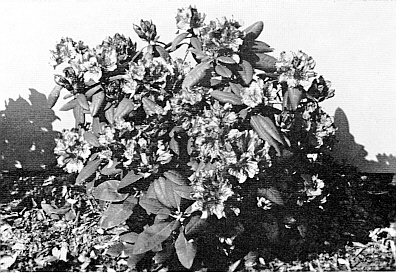
Fig. 32. 'Tony', a dwarf hybrid from the breeding project
of Tony Shammarello.
|
|
|
|
|
|
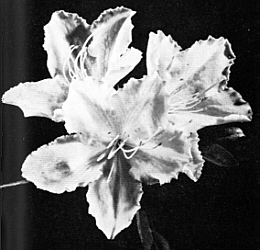
Fig. 33. Azalea 'Desiree', an
introduction of A.M. Shammarello,
South Euclid, Ohio.
|
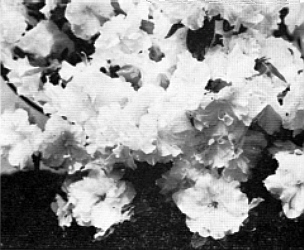
Fig. 34. Azalea 'Helen Curtis', a
Shammarello introduction.
|
|
In the early twenties, in the Cleveland, Ohio, area, rhododendrons were not grown. Local nurseries imported them from Europe for resale until the importation of rhododendrons to this country was restricted. Local nurseries then commenced to grow them by grafts and seedlings. The seedlings intrigued me, although of open pollination there were many of good color and they seemed to have more vigor than the grafted plants.
In the winter of 1935-36 with a scant snow cover on the ground, the temperature dipped to 24 degrees below zero. We had growing in an open field about 500 grafted plants and about 1,000 blooming size seedling plants. Many grafted varieties and seedlings froze into their roots and were a total loss, others were slightly to severely injured. The least injured varieties were the species
R. smirnowii
, the hybrids 'Roseum Elegans', 'Album Elegans', 'Boule De Neige', 'Kettledrum', 'America', 'Mrs. C. S. Sargent', 'Ignatius Sargent' and some hybrid seedlings.
The varieties that were the least injured inspired me to cross pollinate them with the hope of creating seedlings with a greater resistance to low temperature. Also the constant demand for compact plants like 'Boule De Neige' and 'Cunningham's White' in red and pink colors, brought out the idea that by intercrossing them with pink and red hybrids possibly the compactness and color could be transmitted to the offspring.
In the spring of 1936 I made a few crosses, but in a review of the complex parentage of the hybrid parents, I became skeptical that controlled pollination would not produce better seedlings than open pollination so I gave up the idea. As seedlings grew and started to take form several individuals, in some of the crosses, had a resemblance to parents in plant character and color. This encouraged me to resume hybridizing in 1940 and thereafter I made numerous crosses and grew thousands of seedlings to blooming size.
In the course of observation of seedlings, it became evident that some parents, though themselves of maximum hardiness and good color, were unable to transmit these good traits to their progeny. The majority of seedlings were plant and bud tender and of poor color.
It appears that a seedling of a species or a hybrid of complex parentage, is individualistic in its genetic makeup, being either dominant or recessive in its good traits. When there is a combination of two parents of near alike color and both are dominant in color, the majority of seedlings come true to color. However if one parent is recessive in color, only a small portion of seedlings will have the dominant parents color, the other seedlings the colors of their complex parentage. 'Cunningham's White' as a parent is dominant in early bloom and compact plants; the habit of fall bloom is transmitted to a small portion of its offspring.
'Boule De Neige' is dominant in midseason bloom and compact to intermediate plants. 'Roseum Elegans' is dominant in hardiness and the magenta color.
R. smirnowii
is dominant in hardiness, pink colors, intermediate plants; the habit of fall bloom is not transmitted to offspring. 'Catalgla' is dominant in hardiness and color.
R. brachycarpum
is dominant in late bloom and transmits to seedlings a tendency to come into bloom when plants are 8 to 10 years old.
R. fortunei
is dominant in tender offspring. The above is in general terms; reference is to the majority of seedlings. If a hybridizer keeps record of each cross and identity of parent plants he can fairly predict what to expect from certain crosses.
From thousands of seedlings I grew to blooming size, I selected about 100 seedlings for observation, after testing them for 7 to 8 years I selected for introduction in 1961 six clones for their early bloom (about May 10th) and compact plant character, height clones, mid-season bloom (about May 20th) and compact to intermediate plant character and nine clones, late bloom (about May 30th) intermediate to tall plant character and clarity of color.
I was swayed in introducing 23 rhododendron clones because of the continuity of bloom during the month of May and the various plant characters which fill a need in landscaping.
In addition I have introduced 8 varieties of the evergreen type of Azaleas, in view of their hardiness, plant character and clarity of color. Perfection is hardly ever attainable, but improvement in some form is possible which we should continue to strive for.
I have had under observation for the past 4 to 5 years 2 hybrids of
catawbiense
ancestry, of H-1 hardiness with scarlet red bloom (like 'Mars', 'Vulcan') with no trace of magenta which we will continue to observe before introduction.
We have about 150 seedlings of 'King Tut' x
R. yakushimanum
which came into bloom last spring, most the color of
R. yakushimanum
with a larger and fuller truss. I have selected 10 seedlings for observation; it will be several years before we can choose one or two clones for introduction.
I am also working to develop hardy, double pink and red evergreen type Azaleas.