The Windsor Hybrids
A new group of Deciduous Azaleas
James S. Wells, Middletown, N. J.
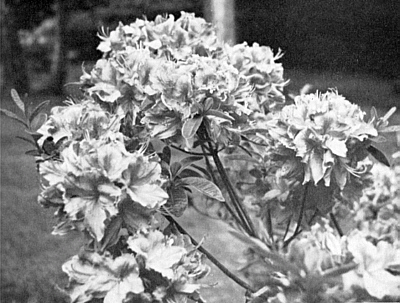
|
FIG. 43. Typical flower truss of a Windsor Hybrid. This is a
deep carmine rose with an orange flare.
Photo by J. S. Wells
|
|
|
|
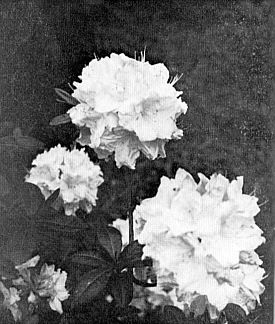
|
FIG. 44. Broad individual flowers and full
round trusses are typical of most
Windsor Hybrids. This is a bright
clear yellow.
Photo by J. S. Wells
.
|
|
As you read this title I can hear you say, "What, another group of Deciduous Azaleas? How many more are we going to get?" Let me explain what the Windsor group is and how it came about and then you can be the judge.
In May of 1970 my wife and I paid a visit to England with the intention of looking at as many Deciduous Azaleas as we could. We went to the Exbury Gardens and saw some beautiful material there. We went to Hilliers Nursery and selected some more and towards the end of our trip, without any particular purpose in mind, we went to visit the Savill Garden in Windsor Great Park. We were there about the first of June and the Azaleas for which the gardens are famous were at the peak of perfection-and what perfection! Mass upon serried mass of many of the old hybrids interspersed with bold groups of a spectacular new range of large flowered hybrids in every imaginable color. What made these plants different to the recognized standard varieties? As we walked around the gardens it seemed to me that the flower form was generally speaking, superior. Now I say "generally speaking" because there is no question that in the Exbury and the Knap Hill as well as the Ilam groups there are plants of exceptional merit. These plants are at the top of the whole range. But looking over the large number of plants flowering in the Savill Garden there seemed to be many plants of this exceptional caliber. Plant after plant exhibited the fine round, bold, fully filled truss, and this combined with the clarity of the colors produced plants of unusual excellence. The yellows were a pure clear yellow, the whites shined with a brilliant whiteness, the reds were startling in their clarity and in addition many of the plants had a most attractive two-tone affect. As each large truss began to open the buds were, in every instance, a deep pink, but when the flowers opened they might be a clear yellow or clear white. The combination of developing buds together with the adjacent opened flowers was most unusual. Naturally enough in walking around the gardens we looked at the name tags hanging on the plants and all that we could find was the simple statement - Windsor Hybrids. Later on we met John Bond, who has since become the Joint Keeper of the Gardens following Sir Eric Savill's retirement. Mr. Bond gave us some background on these plants.
The Savill Garden was commenced about 1932 and after some years a group of Azaleas was acquired from the Exbury estate of Lionel de Rothschild. These came as seedlings unnamed and were planted in various parts of the Savill and Valley gardens. As the development of the gardens proceeded the need for additional plants was clear and it was decided that they should commence to raise some of their own from seed. Mr. Findlay, now the other Joint Keeper, who was then in charge of the gardens under the direction of Sir Eric Savill, began to cross some of the best of the Exbury seedlings which had now developed into fair sized plants. Following the lead given by Lionel de Rothschild, Mr. Findlay selected exceptional plants and crossed two which had unusual qualities of color, size of bloom, or any other quality he considered desirable. The seed was sown, the seedlings brought to flowering stage and then only the outstanding and unusual plants which clearly showed in the mass of the seed beds were selected. The young seedlings were held for three or four years to insure that all would flower but from perhaps a batch of 10,000 seedlings not more than 50 might be selected and these plants were moved into the Savill and Valley Gardens. This careful process of bringing together exceptional parents, raising a batch of seedlings and then selecting with great care the outstanding plants in each batch has now continued for a period of 25 years or more. Plants grown and selected in this way for planting in the Savill Garden and the nearby Valley Gardens can be seen in all stages of development from newly planted stock not more than 15" high to massive plants 10 to 12 feet high and wide which were some of the original selections. Now it would be ridiculous to suggest that all of the plants segregated in this manner have proved to be outstanding. They have not and there are a number of plants growing in the Gardens which may have excellent flower quality but which are not very good growers. There are others which grow beautifully but which do not produce exceptional flowers. But finally, of course, there is a group, which, over the years, has clearly indicated many outstanding qualities. These are indeed exceptional plants in both vigor and quality of growth, size and purity of flower combined with first class flower form. It is these plants which we believe to be worthy of introduction to horticulturalists everywhere. With this in mind, therefore, we discussed the matter with Mr. Bond and at first he and Sir Eric were doubtful of the wisdom of introducing yet another group of Deciduous Azaleas. Eventually, however, we were able to persuade them that if selections were made with great care and these in turn were carefully retested under varying climatic conditions we felt sure there was a hard core nucleus of really outstanding plants which would be a joy to grow and a pleasure for any horticulturalist wherever he might be.
In the Spring of 1971, therefore, my wife and I returned to the Windsor Great Park and with the help of Mr. Bond we selected a group of about 30 outstanding plants from the many thousands of seedlings available. As it turned out many of these came from some of the later crosses for we eventually decided that these were among the best available. Cuttings were brought back as part of our personal luggage and with careful preplanning and excellent cooperation from the U. S. D. A. officials at Kennedy airport these cuttings were passed through the quarantine in 20 minutes and early the next morning were inserted in our propagation benches. As might be expected we found a wide variation of root-ability in this group but only one of the 30 plants selected has not rooted at all. This variety will almost certainly have to be discarded but we do have rooted cuttings of all the remainder and these will be carefully grown through the winter, given artificial light to ensure top growth and we expect to have additional cuttings from them so that by next spring we should have a good working nucleus for future growing on and testing. This testing is going to be as vigorous and as careful as we can make it and we will be quite satisfied if we can select say five really outstanding plants from the 30 we brought over. There is no question, therefore, that these plants will not be available for some time because it is part of our understanding with the management at Windsor that they are not prematurely offered to the horticulture fraternity in this country. Everyone wants to be quite certain that when the Windsor Hybrids are finally available they are indeed as good as we believe they are. This then is the background of these beautiful plants.
It seems to me that once again we are fortunate to be able to enjoy the results of quite an exceptional degree of horticultural skill and judgment. The process which has produced the Windsor Hybrids is essentially the same process which was used 100 years or more ago in England to produce the iron clad Rhododendrons which have yet to be superseded as the mainstay of the Rhododendron world here in the eastern United States. At that time tens of thousands of seedlings were produced by knowledgeable plants men and slowly and most carefully judged to produce the few varieties we still grow and enjoy. This system seems to be unique to English horticulture and I suppose that only an establishment like the Savill Garden could carry out such a process in the middle of the 20th century. It is greatly to their credit and to the credit of Sir Eric Savill and Mr. Findlay that this process was carried on for we believe that the result has been outstanding and exceptional. Time will show whether their judgment and ours is correct but in the meantime we will welcome a visit from anyone who is interested in any of these plants and would care to come to the nursery in flowering time to see them.