An Unusual Specimen of Flame Azalea
(Rhododendron calendulaceum (Michaux) Torrey)
J. Dan Pittillo and James H. Horton
1
Originally published in
Castanea
38:204-205, 1973
1
Department of Biology, Western Carolina University, Cullowhee, N. C.
|
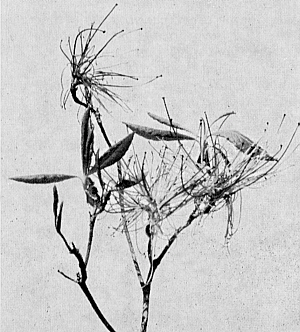
FIG. 13. Branch of a mutant specimen of
flame azalea (about 0.5 normal size) showing
absence of petals. (Both figures reprinted
with permission from
Castanea
38:204.)
|
|
|
|
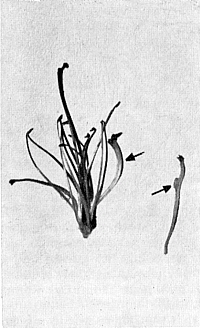
FIG. 14. One flower and one
detached stamen (about 0.7
normal size). Note the petal-
like filaments (arrows).
|
|
A mutant specimen of flame azalea was found in Macon County, N.C. by a summer resident of Franklin, Mr. William C. Brooker. The shrub, about eight feet in height, produces flowers which lack petals (Fig. 13). There are 9, 10, or 11 stamens instead of the usual 5-6 in the flower. The filaments of these stamens are a little deeper and clearer red than those of the usual plant. Occasionally one of these filaments is flattened, suggesting its modification from a petal (Fig. 14, arrows).
Selection of plants in which the stamens have become petal-like has led to the production of the cultivated rose from its wild, many-stamened ancestor. The same process has led to other cultivated flower types, which are usually called "doubled". Such cases are frequently cited by students of plant evolution as evidence that the various whorls of flower parts (sepals, petals, stamens, and pistils) are derived from leaf-like ancestral structures. We believe that it is much more unusual to find the reverse change - petals becoming stamens-and that this situation furnishes just as strong (or perhaps even stronger) evidence for the foliar origin of the reproductive parts of flowers.
Although the branch shown in Fig. 13 is singularly unattractive in the black and white photograph, the overall appearance of the plant is pleasing (at least to us). From a distance, it reminds us of the bottle-brush buckeye
(Aesculus pavia)
or perhaps the more tropical bottlebrushes,
Callistemon
or
Melaleuca
. Thus, from a horticultural point of view, it might make a good background addition for the exotic, tropical type of garden in the more northern areas. A voucher specimen has been deposited in the herbarium of Western Carolina University (D. Pittillo)
An attempt is being made to move the plant and propagate from it to the campus at Cullowhee since its present habitat is scheduled to be cleared. We are grateful to Mr. Buddy Clark, a local nurseryman who brought the plant to our attention for his assistance in this regard.