Pistil Pete Meet Pistil Packin Mama
H. J. Slonecker, Milwaukie. Oregon
|
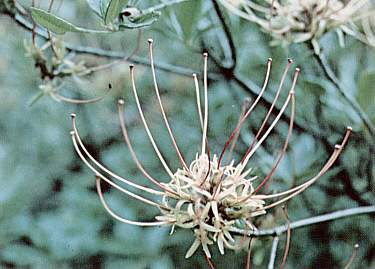
'Pistil Pete'
Photo by Frank Mossman, M.D.
|
|
|
|
|
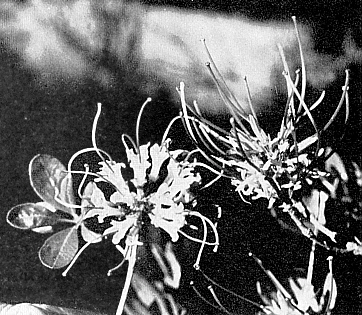
FIG.70. 'Minsikirt' on the left and 'Pistil Packin
Mama' on the right are unusual forms of
R.
occidentale
. The corolla of Miniskirt is the more
developed of the two.
Photo by Frank Mossman, M.D.
|
|
Near Myrtle Creek, Oregon, what must surely be one of the more extensive inland
R. occidentale
habitats has come to our attention. While returning north May 15 on freeway I-5 from Dr. Frank Mossman's post-Conference tour of Occidentale land, Ray James, wife of the late Del James, who was riding with us and using her eagle eye, suddenly exclaimed "Hey, look at that bunch of azaleas on that hill across the river."
Other small patches were noted farther north along the flank of the mountain. At the first freeway exit we turned around and went back to the town of Myrtle Creek. We followed a local gravel road north along the river, but on the side adjacent to where we had seen the azalea patches.
It had been raining and the tall grass was saturated. Having no suitable footwear we only looked at a couple of small patches near the road. I determined to return at the first opportunity to view more of the azaleas.
Little did I know then that I would come back eight times in the next seven weeks, only to run out of blooming season and to come to the conclusion that it would take at least two more seasons to cover the area reasonably well.
This one mountain, reaching an elevation of 2433 feet from its base of about 600 feet at the South Umpqua River and covering an area of about six square miles, is found to have an unique water storing capability. In this area of hot summer temperatures, low humidity, and usually summer-long drought conditions, this mountain releases water through hundreds of springs. They are found throughout its circumference and at the head of at least one large draw at about the 2200 foot level.
The
R. occidentale
plants grow directly in the water emerging from the springs or in any of the surrounding soil that stays constantly moist throughout the summer which is hot and dry until the fall rains come. Much of this soil is under laid with bedrock often only a few inches under the surface. This forces the moisture to stay at the surface in the root zone.
However, since these moist conditions are on the slope of the hill the water is constantly moving and, therefore, no marsh or bog conditions actually exist. It has been our observation that
R. occidentale
, even on the coast, does not grow where static water conditions exist in the root zone the year around. In this kind of a location there may be water over the roots much of the winter, but the water level drops in the summer. As a result the surface of the water is mainly below the root zone but the moisture is readily fed to the roots above by capillary action. On the mountain at Myrtle Creek, the springs are literally the lifeblood of the
R. occidentale
plants and without them these water-loving plants could not possibly survive.
Unlike the surrounding mountains, this mountain is largely devoid of the larger cover trees such as Douglas fir,
(Pseudotsuga taxifolia); Pinus ponderosa;
Garry Oak, (
Quercus garryana
); and Madrone (
Arbutus menziesii)
.
R. occidentale
in this area prefers lots of light. It grows almost entirely in the open and avoids almost entirely the few timbered areas of the mountain.
The azalea patches are quite often bordered with poison oak
(Rhus diversiloba)
which prefers slightly dry conditions. I can tell you that this condition often protects the azaleas from the approach of man! In between the azalea patches the mountain slopes are too dry for additional azaleas to grow. These areas are mainly covered with fairly lush grass, used for beef cattle pasturage, or occasionally covered with chaparral, a near desert shrub.
Only the southerly and westerly slopes have been explored to date and by the accounts of local residents the northerly and easterly slopes have the greatest population. This seems especially true of the north side which was viewed from the top of the mountain and indeed appeared to be the more heavily populated slope. What unusual form awaits to be discovered another year?
To date a number of unusual forms have been found despite the fact that the inland varieties, at least in Southern Oregon, run mainly to the whites as opposed to the coast region. There the pink and colored forms nearly predominate, especially on Stagecoach Hill in Northern California overlooking the ocean. On that hill they reach their zenith as most ably described by Frank Mossman, M.D., and Britt Smith. Perhaps the most unusual ever discovered is their SM #502 pictured in all its wonderful color in the October 1971 issue of the American Rhododendron Society Bulletin.
At Myrtle Creek a fine large white; a form with a frilled border and unusually "square" flowers (overlapping petals); a large white spider form with exceptionally narrow petals; about three forms, all in the same clump and probably sister seedlings, that have the yellow flare usually found only in the upper petals extending into all five petals; and a few exceptionally fine pinks, for inland conditions, have been found.
At least two of the latter are being propagated and it will be interesting to introduce these to Stagecoach Hill to try to determine if the unusual conditions there impart an even deeper coloring. This may go a long way toward disclosing whether the atmospheric and soil conditions there have a large bearing on the coloring, or whether just more outstanding color forms inhabit that area.
The former would appear to be the case in that asexual propagations grown in the Portland area, at least in small plants, seemingly have less intensity of color than their counterparts on Stagecoach Hill.
The two most important and usual forms found at Myrtle Creek, however, are two pistillate forms growing within 200 feet of each other. One has 17 to 22 'flowers' in each truss and has been given the unregistered name of Pistil Pete. The other has 11 'flowers', occasionally 10 or 12, and has been given the unregistered name of Pistil Packin Mama.
At first glance neither of these appear to have petals at all, but an unusually long lobed calyx. Upon closer examination, however, the extended lobe is found to be actually separate from the calyx, although it has the same width, coloring and ciliate texture as the calyx lobe to which it is joined.
Pistil Pete has less green and more white in the petals than does Pistil Packin Mama and appears to be somewhat intermediate between Pistil Packin Mama and the Smith-Mossman discovery, Miniskirt, which grows at O'Brien, Oregon, some 70 miles as the crow flies southwest of Myrtle Creek. The diameter of the cross section of the pistil of Pistil Pete is about one millimeter while that of Pistil Packin Mama is much heavier at about one and one-half millimeters. The color of the pistil of Pistil Packin Mama is a brilliant cardinal red while that of Pistil Pete is a deep pink. The latter is about intermediate between the medium pink coloring of the pistil of any ordinary pink
R. occidentale
flower and that of Pistil Packin Mama.
However, the most phenomenal feature about the pistil of Pistil Packin Mama is that usually at least one, and sometimes as many as three in the truss, split near the middle of the style. These are usually the ones with slightly greater thickness. Something emerges at the split that is akin in some instances to several stamens, but without anthers. These soon dry up, starting at the tip first.
In other instances, a single stem emerges that is similar to a pistil except that the stigma is different from the usual shape. It is a different color, being quite green similar to leaf chlorophyll, but has a sticky substance on it similar to a stigma.
It would be interesting to know if this phenomenon has been observed elsewhere in this species, or in the rhododendron genus or, for that matter, in any genus. Following is a comparative description of the 'flowers':
|
NAME:
|
PISTIL PETE
|
PISTIL PACKIN MAMA
|
|
CALYX:
|
2 to 3 mm in length
|
3 mm in length
|
|
|
5-lobed, densely ciliate
|
5-lobed densely ciliate
|
|
|
color - RHS yellow-green #150D
|
color - yellow-green #145C, tinged with pink
|
|
STAMENS:
|
None
|
None
|
|
INFLORESCENCE:
|
17-22 'flowers'
|
11 'flowers', occasionally 10-12
|
|
PETALS:
|
2½ mm x 1¼ to 1¾ cm densely ciliate outside
|
2½ mm x 1¾ cm densely ciliate
|
|
|
Color - RHS yellow-green #150D
|
Color - RHS yellow-green #145C tinged pink
|
|
PISTIL:
|
Curved 7 cm in length x 1 nun at the base
|
Curved 6½ cm in length x 1¼ to 1½ mm at the base
|
|
STYLE:
|
Color - RHS red #54B
|
Color - RHS red #53B
|
|
STIGMA:
|
Color - brown
|
Color - brown
|