A New Malesian Hybrid
P. H. Brydon, Salem, Oregon
|
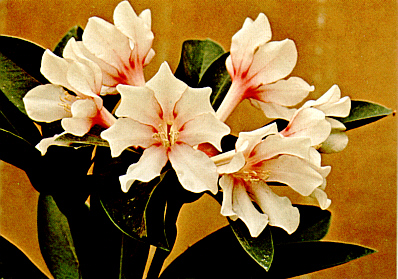
R. leucogigas
Photo by P. H. Brydon
|
|
|
|
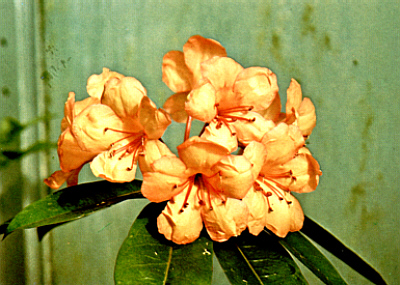
R. 'Sir George Holford'
Photo by P. H. Brydon
|
|
|
|
|
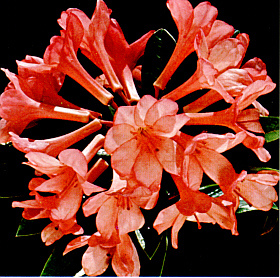
R. 'Sir George Holford' x
R. leucogigas
Photo by J. P. Evans, M.D.
|
|
In January, 1968, while I was Director of the Strybing Arboretum in San Francisco,
R. leucogigas
flowered for the first time in the Western Hemisphere and a detailed account was published in the October Issue of the A.R.S. Quarterly Vol. 23, No. 4. Because of the fragrance, texture, form and size of the flowers, this new species, discovered by Dr. Sleumer in W. New Guinea, has a tremendous potential for the hybridist. Unfortunately, it lacks the necessary hardiness required for less equable climates than its tropical homeland. Nevertheless, attempts were made to combine the fine qualities of this new arrival with hardier species, but to no avail. If any reader knows of a successful cross between any of the Malesian species and their hardier relatives, I would appreciate hearing from them. According to records of the Royal Horticultural Society, there were crosses made between members of the Fortunei Series and certain "Javanicum Hybrids". In 1885, R. 'Pearl' received an F.C.C. It was a cross between R. 'Princess Royal' (
jasmanicum
x
javanicum
) and
R. griffithianum
. About the same period, Mr. Noble introduced R. 'Lord Wolseley' which was a cross between R. 'Duchess of Teck' (a
griffithianum
hybrid) and
R. javanicum
. To my knowledge, neither is in cultivation today.
As I had hoped, the progeny from the cross ('Sir Geo. Holford' x
R. leucogigas
) made at Strybing has the shorter inter-nodal growth and more compact habit of 'Sir Geo. Holford', the seed parent, plus the heady fragrance of
R. leucogigas
, the pollen parent. In a recent letter from Dr. John Evans, he enclosed the color transparency illustrated on the color page and describes it as follows "this is the best truss of your cross of 'Sir Geo. Holford' x
leucogigas
. There are three of them now planted out in the new rhododendron area just past the succulent garden (in Strybing Arboretum, S.F.). They are growing well and we expect that they will become large vigorous plants... The flowers are fragrant, the truss is 1 1 inches across with an excess of 24 corollas". He also stated that out of eight plants in the Arboretum, two survived during the December, 1973 freeze when temperatures dropped to 23 degrees F. Obviously, Malesians are not for general garden use along the Pacific slope. However, consider the possibilities for the florist industry. Many of them are delightfully fragrant, i.e.
leucogigas
,
konori
,
zoelleri
, and many have brilliant color combinations unknown in their hardier relatives. In others, the flowers have great resistance to hot weather. For example, A. W. Headlam, writing from Australia, stated that
R. laetum
flowered in January when temperatures ranged from 94 to 110 degrees F. Yet when the flowers finally dropped in mid February, the color (a rich daffodil yellow) had intensified rather than faded. In habit, the Malesians range from low pendulous plants, as in
R. rarum
, to small leaved erect heath-like plants, as in
R. womersleyi
, and handsome foliage plants as in
leucogigas
and
konori
. In addition, Malesians are native at latitudes between 15 degrees north and 15 degrees south where daylight is almost equal to dark and where there is relatively little variation in seasonal temperatures. Consequently, mature plants tend to flower, put on new growth, and flower again the same year. Peter Sullivan, at Strybing Arboretum, is creating some very exciting hybrids as are some of the growers in Australia. Michael Black in England has suggested that
R. kawakamii
, a member of the Vireya Section and native to Formosa at 7000 ft. altitude, may be compatible with the Malesians and, if a successful cross were made, would provide a measure of hardiness to the exotic species from Malesia. Species belonging to the Stamineum and Irroratum Series occur in Malesia and might provide the bridge. Disregarding the possibility of combining hardiness with the beauty of the Malesians, is it not possible that the hybridist would re-arrange the many desirable qualities of these Malesians and produce a low, compact highly colored, fragrant race of Rhododendrons suitable for pot culture and which would flower more than once a year? Perhaps in time they would replace the ubiquitous Chrysanthemum!