PUKEITI - 25 YEARS ON
Graham Smith, Curator
|
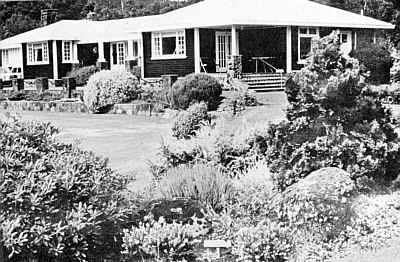
The lodge at Pukeiti in 1972.
Photo by Pukeiti Rhododendron Trust
|
|
|
|
|
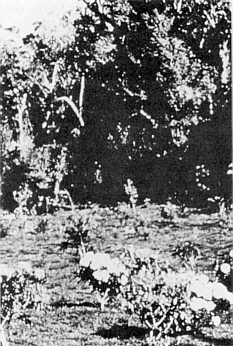
Pukeiti planting in 1956.
Photo by Pukeiti
Rhododendron Trust
|
|
|
|
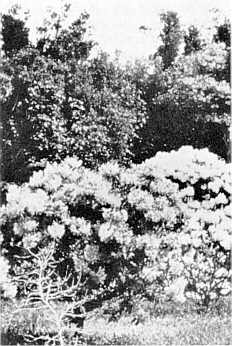
The same planting in 1975.
Photo by Pukeiti
Rhododendron Trust
|
|
On October 30th this year the Pukeiti Rhododendron Trust, New Plymouth, New Zealand, celebrates 25 years since W. Douglas Cook cut the ribbon that began the turning of a dream into reality. Members of the Australian and American Rhododendron Societies will know just what that means in terms of hard work and determination. This is an opportune time to look back on what has been achieved in that period.
"Pukeiti" means "Little Hill" and this volcanic cone is 1601 feet high, and is part of the volcanic ranges close to New Plymouth, which terminates in the 8260 foot peak of Mt. Egmont. Being on the west coast of the North Island and only 10 miles from the Tasman Sea, the prevailing westerly winds are generally moisture laden and the rainfall of 135" per annum is proof of that. This is spread evenly throughout the year. The resulting high incidence of cloud cover reduces temperature fluctuations and the severity of frost. Ground temperatures can dip to -8°C in open spaces, but bush areas remain frost free. In short, it is a cool temperate rain forest highly suited to rhododendron cultivation.
The foundation members inherited 150 acres of densely bush-clad, undulating country. It had originally been logged over 40 to 50 years previously and the resultant secondary growth had already reached large tree proportions. Old logging tracks criss-crossed the area and afforded reasonable access. All this was in 1951. By October 1954 the Trust's area had grown to 450 acres and a fine Lodge had been built by the members. Membership, fixed at 2 guineas per annum, had risen to 500. Today, cost of membership has barely risen to $5 N. Z. but total membership is near the 3000 mark and is worldwide.
By the end of 1955 the Trust area had reached the 900 acres it stands at today. The first plantings of hybrid rhododendrons had been made and hundreds of young plants were lined out in a nursery in front of the Lodge. The bulk of these had been imported from Britain. Rough tracks were being formed through the bush, taking in delightful mountain streams and other natural features. The Lodge was supplied with water and power via a waterwheel, and even though power is taken from the National Grid today, the waterwheel continues to provide water for two houses, and all irrigation.
A resident Curator was living at the Lodge at this time but the bulk of the work was still done by volunteers. The administration was handled by a Committee headed by the Honorary Superintendent, Mr. J. W. Goodwin, and they were responsible for the basic layout of the garden. Rhododendron species are grouped within their series and generally kept separate from hybrids. Particularly sheltered areas were set aside for the planting of large leaved rhododendrons and the open spots left for the hybrids.
Few people had tried to garden in such conditions and inevitably mistakes have been, and still are, made. The dense native bush dominated by Kamahi (
Weinmannia racemosa
), Hinau (
Elaeocarpus dentatus
), Tawa (
Beilschmiedia tawa
) and Maire (
Gymnelaea cunninghamii
) provides good shelter but any alteration by clearing causes wind problems. Plants do not form good roots in the constantly moist soil and are readily wrenched by strong winds. Phytophthora root-rot is present and a few losses can be expected each year. It is basically a problem we must live with as nothing can really be done of a practical nature to control it. The soil is as free draining as could be imagined and all plants are sited on mounds 12" above normal soil level. It certainly makes the root system develop more strongly, but is not infallible. To reduce wind damage we do not now clear large areas of bush for planting but concentrate on small bays either side of winding tracks. Aesthetically it is more attractive and maintenance is reduced.
Pukeiti is evergreen rain forest and not readily suited to deciduous subjects. After initial success with Magnolia, Prunus, Betula and other subjects associated with woodland gardening, problems occurred. The Australian opossum, originally introduced by settlers for fur breeding is now a major pest, and they developed a taste for most of the exotic deciduous subjects.
They have killed dozens of trees and establishing a Magnolia today is nearly impossible. The climate is also against these plants except where they naturally grow in high rainfall areas. i.e.
Prunus campanulata
is happy, but Japanese cherries are marginal. Subjects which have done well include Stewartia, Enkianthus,
Rhus americana
, Corylopsis, Forsythia,
Cornus controveisa
,
Styrax japonica
,
Acer hookeri
and
Magnolia cambelli
when established. Of the evergreen exotics
Michelia doltsopa
is the best and flowers profusely in spring. It even sows itself around the place. Autumn colour is not the feature it can be where cool nights are followed by warm, sunny days. However, Rhus, Enkianthus, Stewartia, Fothergilla and deciduous azaleas all give a good display.
With the basic establishment of the layout of Pukeiti by 1960 things settled down to consolidating what had gone before. The main walking tracks were reshaped and drained where necessary and then grassed down. What was the rhododendron nursery in front of the Lodge became an acre of velvet lawn surrounded by mixed borders, beds of dwarf conifers and terrace beds for alpines. The winding drive from the road was sealed and wide herbaceous and rhododendron borders created each side. Once again the unique climate offered unusual opportunities to try different plants, and big drifts of Primulas, Hostas, Rodgersias, Astilbes and
Iris kaempferi
are a feature today. Meconopsis, represented by about ten different species, are very much, at home and regenerate naturally. All these are grown in full sun to give best value.
Cardiocrinum giganteum
, the Giant Himalayan Lily, is an outstanding feature around Christmas time and looks particularly affective amongst large leaved rhododendrons. The original bulbs were grown from seed scattered around the bush margins. Seedlings now appear like a grass sward in many areas and instead of having a few hundred towering flower spikes they will eventually number thousands.
By the mid-sixties a second staff house was built and general maintenance, which was increasing to beyond volunteer labor capabilities, was improved. New rhododendrons were constantly being added to the collection. An overseas trip to Europe by the Honorary Superintendent brought a rush of new material, especially rhododendron species from seed. A major development of this period was the creation of a Himalayan valley, planted with large leaved rhododendrons. The slopes of the valley are steep and a winding path around the top gives fascinating views down on top of the plants. In time, the rhododendrons will be at eye level and it will be a tremendous spectacle. The species planted, which include
R. mollyanum
,
sinogrande
,
magnificum
and
macabeanum
, are now about ten feet high and starting to flower regularly. The "Valley of the Giants'", as it is called, is really something for the future.
The native flora has not taken a back seat during this period and wherever possible track margins are strengthened by the inclusion of ferns and choice shrubs. Several borders close to the Lodge are devoted entirely to native plants. Here can be seen a representative collection of New Zealand trees, shrubs, and ferns with a special emphasis on the good foliage plants that abound in these islands. Red, yellow, cream and pink striped flaxes (Phormium sp) silver Astelia, bronze and green cabbage trees (Cordyline sp) and bronze and variegated five-fingers (Pseudopanax sp are just a few worth mentioning. Even maintenance is geared to preserving the natural flora, such as delaying mowing bush tracks until ground orchids have flowered and set seed.
It became apparent in the late 1960's that a staff of two was just not enough to continue the expansion and maintenance and plans were laid to increase the workforce. By this time Pukeiti's finances were reasonably healthy and the very important step of forming an investment "Trust Fund" had been taken. Pukeiti's relative isolation meant that another house was required for staff and this third one was built in 1973. Despite this increase in permanent staff the volunteer spirit is not lost and working bees are still held once a month. Recently, members planted 250 specimen rimu or red pine trees (
Dacrydium cupressinum
) to help replace those logged years ago. With a life span of 300 years this was really planting for great-great-grandchildren. Such is the spirit of the members that many are prepared to travel hundreds of miles to help out. We hope one day to build simple cabin accommodation for such members so that they may get maximum pleasure and participation from Pukeiti.
I came to Pukeiti in 1969 when most of the pioneering work had been done and early plantings were in their full glory. The rhododendron collection was already extensive but heavily biased towards hybrids. I made a trip to Britain in 1972 and since then using connections made at that time and more recently the American Species Foundation, the collection has more than doubled. Our aim is to grow as many species as our climate will allow to give New Zealanders a chance of seeing and comparing this wonderful genus of plants. We are just extending our range into the Malesian rhododendrons and the major project of 1976 is the erection and landscaping of a glasshouse for these. Malesians have been tried outside at Pukeiti but to give them frost free positions generally means a bush setting with a reduction in light intensity. Flowering is somewhat retarded (or non-existent) under these conditions, therefore the glasshouse will be a great step forward. This will be opened to the public on October 30 this year.
An article such as this would not be complete without a closer look at what is grown and how they perform. The Grande, Falconert and Maddenii series are very much at home.
R. magnificum
,
protistum
and
giganteum
start the season off, appearing in July and August. Some are already reaching tree like proportions with 25 feet being the tallest. A fine
R. giganteum
grown under K. W. 21498 has enormous rich pink flowers of great quality and would be the finest in the garden. Within the same group a hybrid seedling of
falconeri
x
macabeanum
is good. It was raised at Glenarn, Scotland and has the foliage and habit of
falconeri
with fine yellow, maroon blotched flowers like
R. macabeanum
. Of the Maddeniis
R. nuttallii
,
R. lindleyi
and
R. rhabdotum
are supreme and planted in large numbers. Another beauty is
R. ciliicalyx
K.W. 20280 with blush pink flowers, exquisitely scented, which smother the compact plants in October.
Other series well represented include the Arboreums, none of which are troubled by our frosts.
R. arboreum
var.
kermesinum
is a dark red, small truss, but very prolific and held above dark green shiny foliage which is attractive all the year round.
R. floribundum
is good in both flower and foliage and is late, but later still, just before Christmas usually, is
R. insigne
with lustrous, copper-sheened foliage and tight trusses of pink flowers.
Evergreen azaleas are a feature of Pukeiti with September and early October bringing a patchwork quilt of color provided by thousands of hybrids. A bank of
R. simsii
is a wall of orange-red later in the season. Deciduous azaleas are not as satisfactory, but grow and flower reasonably well.
The Fortunei series does well with pride of place going to a pure white
R. decorum
with a bright pink style. A double form of
R. griffithianum
, again pure white and scented, also causes a great deal of comment.
R. orbiculare
,
R. oreodoxa
,
R. houlstonii
,
R. hemsleyanum
,
R. diaprepes
and others are well represented.
If any one plant evokes comment from both expert and layman alike it is
R. yakushimanum
. Our plant is the F.C.C. form and is now about 25 years old, 5½ feet high and 10 feet in diameter with perfect symmetry. Hardly a leaf can be seen when in flower. A nearby youngster, moved last year to give it room, is only 2 1/2 feet by 4 feet! We have long since ceased going by nurserymen's descriptions of rhododendrons where size is concerned. The hybrid "Winsome" listed as "dwarf-compact" has been re-spaced twice, but at 8' x 10' and still growing vigorously we have given up.
I hope this brief mention has whetted your appetite to come and see for yourself the work of Pukeiti. This is an important milestone for us and we welcome your participation. See you in October!