Fasciation
Arthur W. Headlam, Bentleigh, Australia
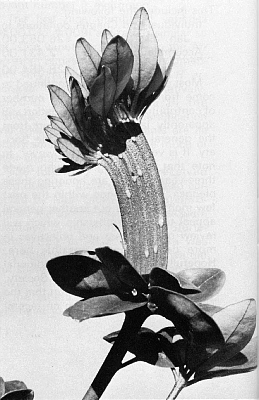
No doubt, most rhododendron enthusiasts have at some time or other observed the results of fasciation, generally taking the form of a strap-shaped structure of stems, often several inches broad, in which a number of stems joined side by side have emerged from the growing point instead of one normal stem.
Each stem in the strap usually produces its normal quota of terminal leaves, as well as a flower to each terminal, but generally the leaves and flowers are much smaller than normal. One rhododendron in Australia which intermittently produces this type of fasciation is 'White Pearl'.
|
|
No. 1.
R. christianae
x
R. jasminiflorum showing strap-like fasciation of stems. Photo by Arthur Headlam |
Fasciation has also been observed in the Malesian hybrid
R. christianae
x
R. jasminiflorum
, in which five stems have emerged from a growing point. As a matter of interest, one such fasciated growth was split with a razor blade back into five single stems, each with some terminal foliage, and these were propagated and grown on with the result? Five perfectly normal plants of
R. christianae
x
R. jasminiflorum
!
Fasciation appears to be more common with the genus Lilium, and particularly so when grown in a very rich soil, a group of flattened stems up to seven to eight inches wide being not an uncommon sight: however, the purpose of this paper is to describe an unusual form of fasciation affecting two plants growing in the glass house in the National Rhododendron Garden at Olinda,
R. lochiae
and the Veitch hybrid 'Triumphans'.
It is necessary to go back a couple of years to the time when Brian Clancy and I undertook the not inconsiderable task of up-grading, re-planting and adding new plants to the collection. Many Saturdays were spent on this interesting and enjoyable project in the glass house, set in the idyllic surroundings of the National Rhododendron Garden.
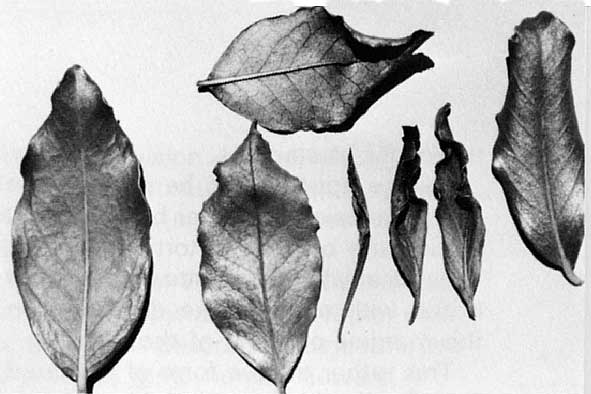
Progress was steady and the glass house which contained some three hundred species and hybrids was gradually becoming a focal point of interest. On entering the glass house some days prior to the main 1976 November Show to add some more plants just on the point of flowering, we were dismayed; practically every plant suffered from browned and distorted foliage and flowers were virtually non-existent. Many small plants were obviously dead. What had happened? We immediately endeavored to try and determine the cause of the disaster.
After making extensive enquiries, we were left with two possible explanations. The gardener had some few weeks previously been asked to spray the plants with Folimat 80 to control an infestation of red spider. Had the knapsack spray which he used been previously contaminated with a hormone type weed killer used for the destruction of blackberries? We were assured by the gardener that this was not so.
|
|||||||
|
|||||||
|
We had been aware for some considerable time that with the water from the dam operating a sprinkler system, a very fine deposit of silt was precipitated on the foliage of the plants in the glass house, the build up of which certainly adversely affected transpiration of moisture from the foliage.
Enquiries also revealed that it was generally known that the water from streams and springs in the Dandenong Ranges contained an excess of aluminum, causing problems in other areas with potato growers. When watering their crops in normal circumstances, no problems were encountered, but as summer progressed and the water level in the dam dropped and water was pumped from 'the bottom of the barrel', aluminum concentrations increased with disastrous results, causing blackening and distortion of the foliage.
This led to an examination of the pipe intake to the pump in the dam in the Rhododendron Garden; the inlet pipe was found to be at a very low level which no doubt contributed to the water being contaminated with silt and possibly other elements. The inlet level was raised considerably, since when no further problems have occurred.
After five to six months, many of the larger plants in the glass house showed signs of a slow recovery and the plants which did not survive were eventually replaced. In spring 1977, flowers again began to appear and two unusual flowers were noticed amongst the normal flowers on
R. lochiae
. They appeared to be double flowers but, unfortunately, were just at the point of disintegration which made close examination quite difficult.
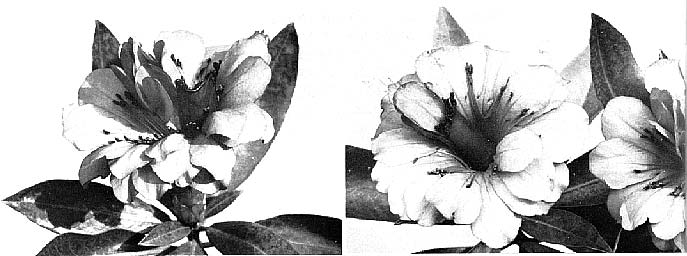
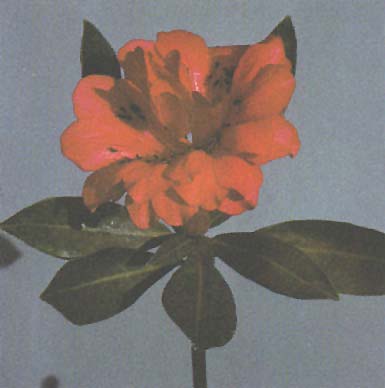
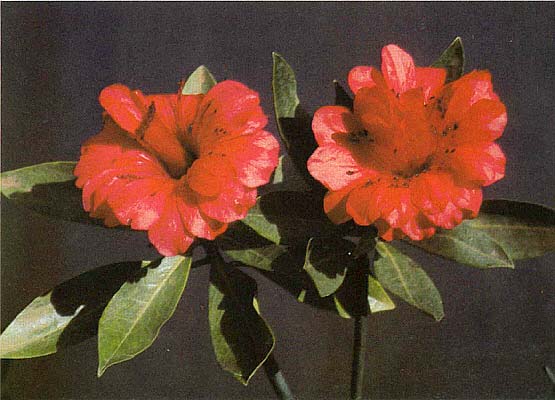
Several months later, a plant of the Veitch hybrid 'Triumphans' attracted attention with its colorful display of red flowers, amongst which were three most unusual specimens; fortunately, they were in excellent condition and I was able to photograph them in both color and black and white.
The flowers measured four inches in diameter and the pedicels were joined to form an almost complete circle and were approximately one and one half inches in length. The styles were ribbon shaped, slightly curved and one half inch wide and the stigmas appeared in a row along the top of the styles. A count of stamens revealed 50, 60 and 60. The large flowers appeared to be made up of a fusion of some six flowers as was indicated by the count of stamens.
Foliage appeared to be normal, but some leaves on the lower branches still carried the original distortion. The foliage on all affected plants was stiff and brittle with a ripple like distortion on the margins of some of the leaves.
This rather unique form of fasciated flowers raised in my mind the question that it may have been caused by either one of the two previously mentioned possibilities, or perhaps, a combination of both, particularly after reading a paper on fasciation in the Auckland Lily Society's December 1977 Bulletin. "In garden lilies too, certain hormonal sprays can cause fasciation when accidentally applied (e.g., those containing 2, 4-D or 2, 4, 5-T), however, these fasciated stems usually only occur in one season, and in the following year normal stems will appear".
David G. Leach in Rhododendrons of the World states: "Countless plants have been killed by aluminum sulphate, which is frequently recommended as an acidifying agent in popular garden publications. The fact is that rhododendrons have a narrow range from the tolerance to toxicity of aluminum ions and there is a cumulative increase of them as the chemical further acidifies the soil. Repeated applications are especially undesirable. Practical observations amply supported by experimental evidence prove that aluminum sulphate can be extremely injurious to rhododendrons". Whether the fasciated flowers of
R. lochiae
and 'Triumphans' were due in some measure to the conditions prevailing in the glass house is difficult to determine. The fact that out of some 300 plants only two have produced fasciated flowers makes the chance of recreating the conditions very remote, that is, if it was in fact caused by a combination of circumstances. There is, of course, always the long chance that it may have occurred in any case. The question led me to believe that it would be worth while to carry out a few experiments.
Three healthy plants of
R. lochiae
x
R. laetum
were selected and placed in an isolated corner of my garden. No. 1 was sprayed at weekly intervals with 2,4,5-T., commencing with a twenty times weaker than normal concentration, and increasing the strength each week until at the end of ten weeks, the full recommended strength solution was applied. It took almost until the last week before any result became apparent; the foliage wilted, browned and the plant died within about ten days but no distortion of the foliage occurred.
Plant No. 2 was given a foliar spray each week for 12 weeks with aluminum sulphate, half ounce to one pint of water, and the residue of the spray was each time poured into the container without any obvious result. This treatment was discontinued for 6 weeks and then resumed for a further 12 weeks. During the commencement of the second application, three normal heads of flowers were produced. Plant No. 3 was given the same treatment as No. 2, but with the addition of a foliar spray once each four weeks of 2,4,5-T at ten times weaker than normal dilution, the only apparent effect being some slight curling of a few not fully mature leaves; certainly, nothing like the distorted leaves in the glass house.
A test disclosed that the mixture in containers 2 and 3 consisting of shredded fern fiber, peat moss and rotted oak leaves after the application of aluminum sulphate, registered pH 3.5.
Fasciation can either be induced genetically or environmentally but, in either case, the mechanism of abnormal cell division is the same, even though the stimulus which produced the aberration in this case has not been identified.
The plant of
R. lochiae
x
R. laetum
which was subjected to the rather drastic treatment described has continued to produce quite normal flowers.
A close watch is being kept on the plants in the glass house to see if any more fasciation or leaf damage occurs.
The reason that this description has been submitted to the Bulletin is to enable readers to see what is considered to be a quite unusual phenomenon and, at the same time, enquire if growers in the U.S.A. have experienced any similar occurrences.