Vancouver Artist - Mary Comber Miles
David Bar Zvi, Vancouver, BC
|
|
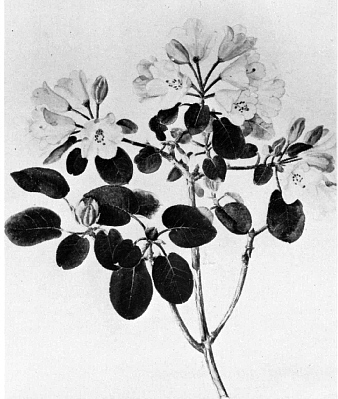
Rhododendron callimorphum
|
|
|
|
|
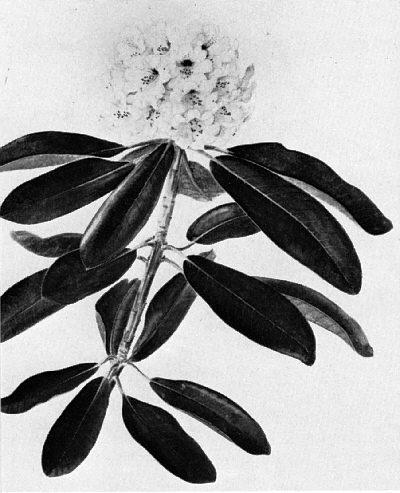
Rhododendron fictolacteum
|
|
|
|
|
|
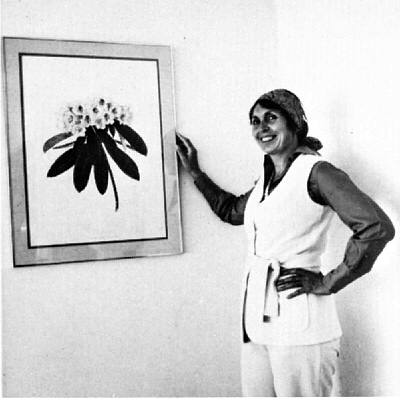
Mary Comber Miles
|
For well over a year prior to the Rhododendron Conference of May 1979 converging on Vancouver, B.C., Mary Comber Miles had been working with studious intensity on many of the botanical portraits that we were privileged to see on the visit to Van Dusen Botanical Garden. They really provided an extension of the Rhododendron tour with a wonderfully different dimension, focusing our attention on some of the less familiar but spectacular rhododendrons grown in this area.
Admitting that rhododendrons are among her favorite subjects, both for their intrinsic beauty and for some of the interesting challenges, Mary chooses to paint life-size. This added to the feeling of an extended rhododendron tour on the visit.
One could almost surmise that her interest and ability in botanical illustration are the genetically predetermined result of being of the fourth generation of Combers actively interested in plants. Mary was the daughter of Harold Comber, A. L. S., the noted plant explorer, botanist and horticulturalist. Her mother taught drawing and design. Plants were as much part of Mary's childhood as talking dolls are a part of today's modern child's focus. True, environment had something to do with it all, but with a little nudge here and there, Mary developed a passionate need to express through her subjects. It's all well disguised behind a cool British manner which also must have been an inheritance from her parents. who moved to North America when Mary was a young woman.
Her interest in things botanical and her desire to develop and direct her artistic talent took her to the Cambridge School of Art, which was conveniently near the Cambridge Botanical Garden.
Today Mary is the official artist for the Vancouver Botanical Gardens Association. Once again it allows for a symbiotic relationship which is necessary for a botanical illustrator. To be closely associated with an established botanical garden helps to create the right conditions for credible botanical art to emerge. The luxurious benefits to a botanical garden in this relationship are obvious. Association with a botanical garden has advantages to the artist also in being an obvious source of interesting plant material. The artist has technical problems in trying to keep the specimen fresh while she paints it. Some rhododendrons can offer a special challenge in being so large that they can become nevertheless very complex to render life size with every pertinent detail. Often a botanical painting has had to be first on the priority list of activities for weeks at a time, coming before family and friends. Sometimes there are more flowers than food items in the refrigerator. For Mary, accuracy of detail, texture and colour are essential, so headaches and back strain have become occupational hazards, due to long hours of concentration and sitting in awkward positions. This need for accuracy has proven to be the mother of some ingenious use of media combinations in order to achieve the effects. Water soluble acrylic paint can sometimes give a certain quality or intensity. Ink might be useful in some cases. 'Improving' on nature is not Mary's style. Falling short of representing the real feel and quality of the flowers and plants which she paints is also out of the question and demands some ingenious solutions to achieving these things.
Mary has shown internationally and shall do so again. Her beautiful rhododendron portraits are only part of her work. Recently she returned from East Java where she spent weeks painting orchids. Hopefully we will see some of these in the near future. She also did drawings for a book on Javanese Species orchids by her brother James Comber which is now being published. She regrets that some of the tropical Rhododendrons were not in bloom while she was there - so do I. Somehow I would like to see these charming plants with infinitely more life and realism than any photograph can show. Oh well, perhaps another year.
|
|
Rhododendron leucogigas
|
|
|
|
|
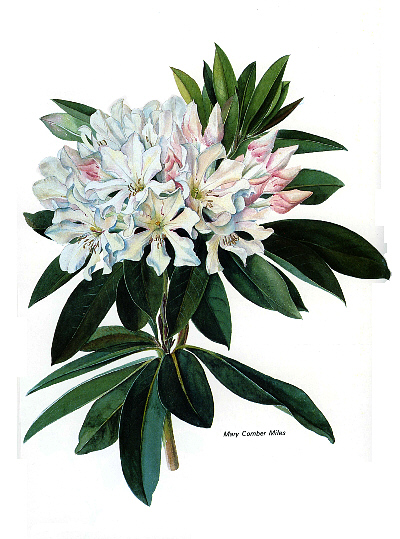
R. 'Pacific Glow'
|
|
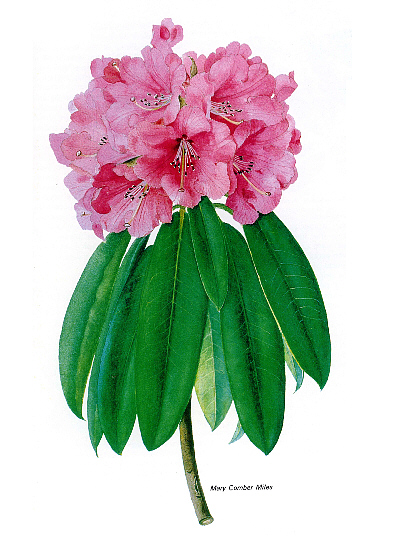
Rhododendron fictolacteum
This particular plant was donated by Alleyne Cooke who grew it in his Vancouver garden. It is native of the pine forest of Yunnan and Szechwan provinces of China and is one of the hardiest of the large leaf rhododendrons. With a little protection from drying winds in winter several specimens are grown in our vicinity in public and more often in private gardens. One very successful protective method to grow it and other somewhat tender species is to surround it with other plants which are gradually moved away as the specimen grows.
Rhododendron callimorphum
is native to 9,000" to 11,000' altitudes of Northeast Burma. Even young plants can be covered with masses of flowers and the plant generally lives up to its name by having a "beautiful form."
Rhododendron leucogigas
This plant grown by Miss Jack at the U. B. C. Rhododendron Nursery. A magnificent Rhododendron from New Guinea introduced to North America by Dr. Sleumer in 1961. It was first grown in America from a cutting which had been in the mail for almost three weeks at Strybing Arboretum. The seeds from the first flowering of this have produced many of the American plants now in collections here. This particular plant (Mary has painted most of it) in the hot summer of 1977 had at that time twenty-seven florets on two flower heads. It flowered again in the fall of 1978 and in the spring of 1979 with approximately thirty-two florets. Flowering in the cooler season, much more colour was evident.
Rhododendron 'Pacific Glow' (R. 'Loderi Venus' x
R. strigillosum
). Newly registered (1979) and grown by Evelyn Jack at the University of British Columbia for Mr. H. L. Larsen of Tacoma, Washington, who bred the plant. It was painted by Mary who was asked to name it, which she did after the evening skies which are so much a part of the Pacific Northwest.